When companies discuss MRP, the first benefit often mentioned is that the system can automatically generate purchase requisitions. That benefit is real, but it is only one part of the value.
A more complete MRP benefit assessment should look at the whole planning chain: demand input, master data, net-requirement recalculation, PR or planned-order generation, execution feedback, and exception control.
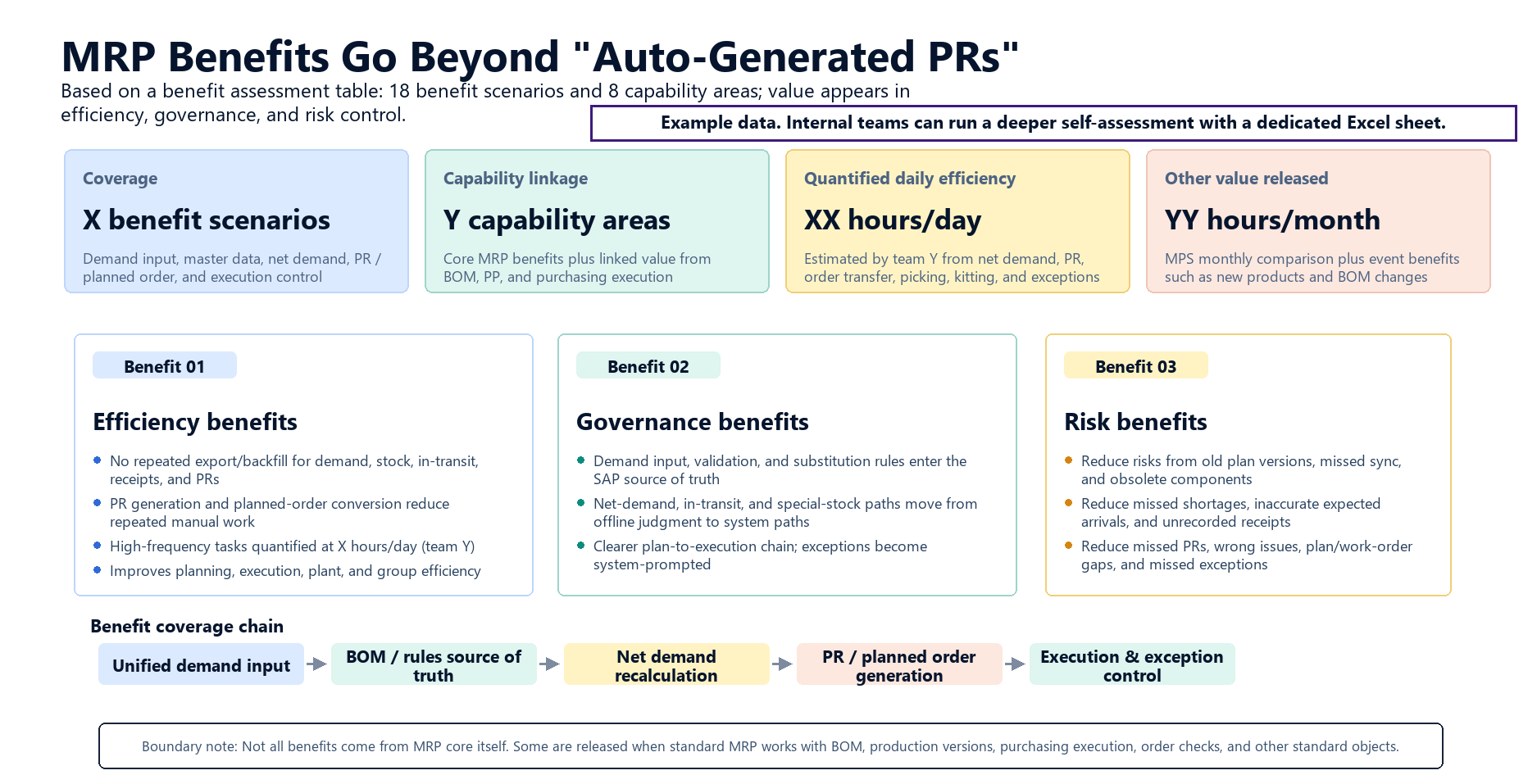
Three benefit areas
The first area is efficiency. Demand, stock, in-transit quantities, goods receipts, and purchasing requests should no longer be repeatedly exported and reconciled in offline files. Standardized PR generation and planned-order conversion can reduce repeated manual work in daily planning and execution.
The second area is governance. Demand input, validation, and substitution rules need to move toward a shared source of truth. Net demand paths, in-transit paths, and special-stock paths become clearer when offline decisions are moved into controlled system rules.
The third area is risk control. A stable MRP process reduces the risk of using outdated plans, missing synchronization, applying obsolete components, overlooking shortages, and letting exceptions slip through manual handover.
Assessment boundary
Not every benefit comes from the MRP engine alone. Many benefits are released only after standard MRP works together with BOM governance, production versions, procurement execution, order availability checks, and exception handling rules.
That is why JRS recommends evaluating MRP not only as a calculation function, but as a planning operating model that connects data, rules, execution, and exception management.